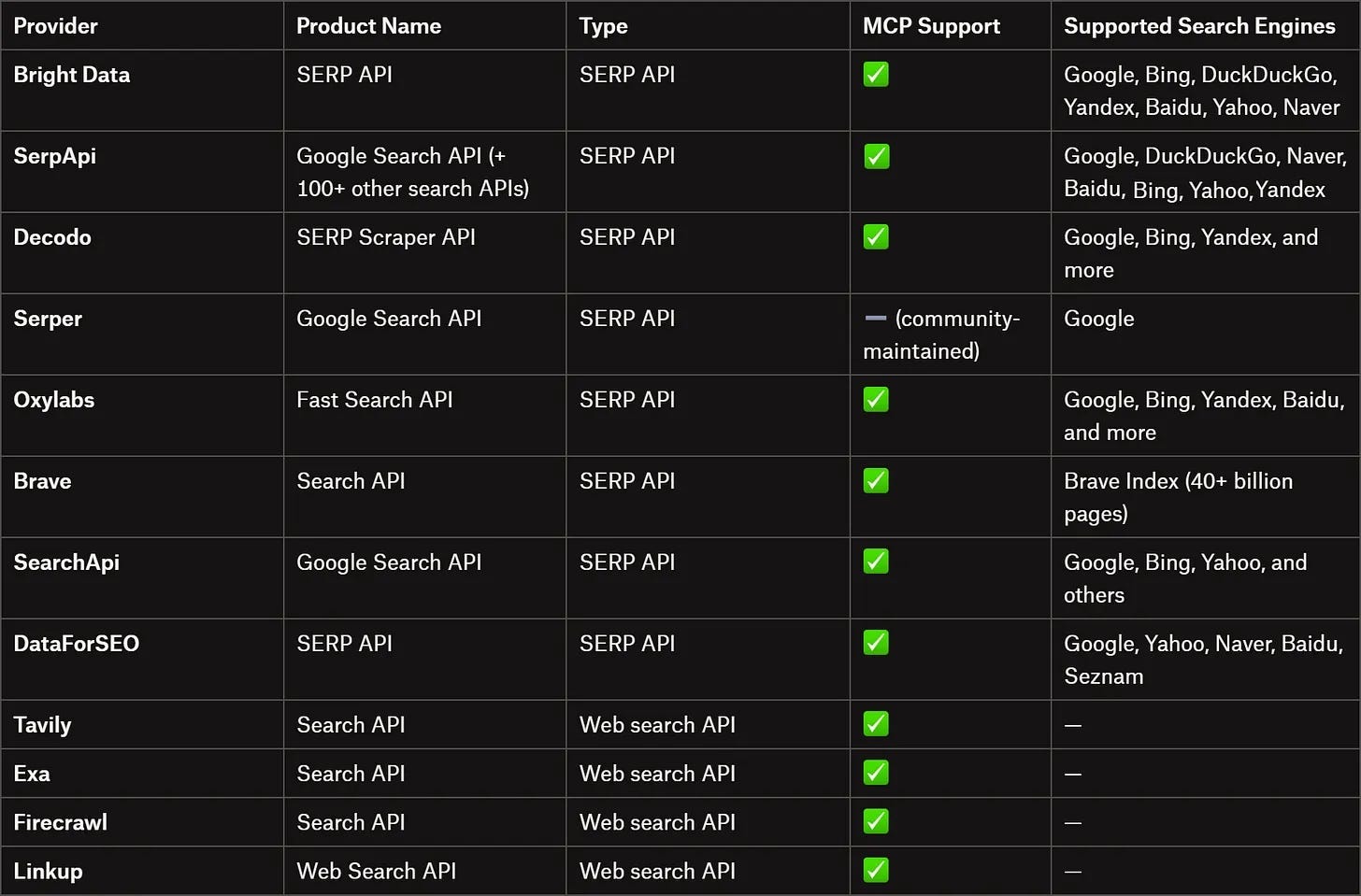
The web data retrieval landscape has evolved dramatically over the past few years, particularly when it comes to accessing web search results. Today, you can choose from specialized APIs tailored not only to traditional SEO-based search workflows but also to AI agents and modern LLM-based applications.
In this post, I’ll explore the world of SERP APIs and web search APIs, explain how and where they differ. I’ll also compare their use cases and how they work under the hood.
Why the Confusion Between SERP APIs and Web Search APIs?
Talk to people in the web scraping industry, and you’ll notice that many use “SERP APIs” and “web search APIs” interchangeably. That confusion didn’t emerge by accident... It reflects how the market has evolved alongside the new demands of AI-powered applications.
Let me cover how we got here!
The Traditional SERP API Era
For years, SERP APIs were the standard solution for accessing search engine results. These solutions are built around SEO professionals, competitive analysts, and market researchers who need reliable access to search data.
SERP APIs provide a straightforward workflow:
Send a search query to a given search engine through an API endpoint.
That’s where the name “SERP API” comes from. The model is simple and effective for its intended audience.
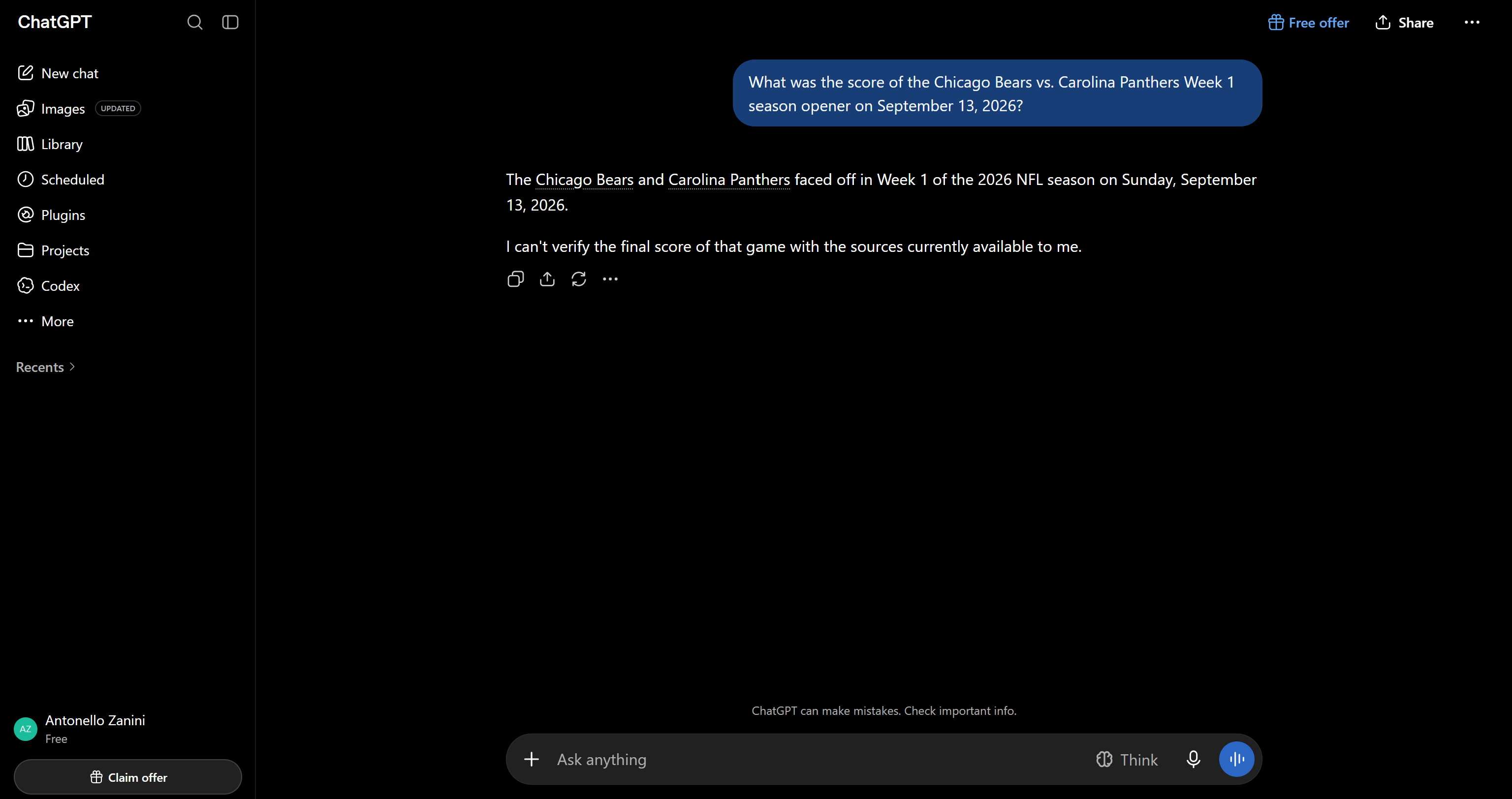
However, the emergence of AI systems introduced new requirements. Traditional LLMs have knowledge cutoff dates and can’t access real-time information on their own. to retrieve and ground their responses in current information, they need external tools.
As users increasingly expected AI systems to answer questions about recent events, breaking news, and other up-to-date topics, responses such as “Sorry, I don’t have information about this event because of my knowledge cutoff” became less acceptable.
Asking ChatGPT a question about a recent event with “Web search” tool disabled
This created an opportunity for a new category of tools: web search APIs, built to help AI agents and LLM-powered applications retrieve relevant information from the web.
Give your AI a web data layer – Decodo's Web Data API turns any site into clean, structured data your models can actually use.
As demand for AI-powered search capabilities grew, something interesting happened in the market. In detail, existing SERP API providers recognized the opportunity and began adapting their products to meet the needs of AI applications.
Some providers transformed their existing solutions into AI-ready products by adding:
Integrations to simplify adoption, such as MCP servers, agent skills, OpenAPI specifications, and plugins for frameworks such as LangChain, LlamaIndex, OpenClaw, and more.
Some of those companies even rebranded their SERP API products entirely as “web search APIs.” At the same time, new providers launched purpose-built tools designed specifically for AI applications, including Exa, Tavily, and others.
This combination of approaches created the confusion we see today. Are SERP APIs and web search APIs the same thing? Not exactly. Are they completely different? Not quite.
The reality is more nuanced…
What Are SERP APIs and Web Search APIs?
Time to take a closer look at SERP APIs and web search APIs, and understand whether you can use the former to implement the latter.
SERP API: Definition
A SERP API, short for Search Engine Results Page API, automates the extraction of data directly from search engine results pages, such as Google, Bing, Yandex, Brave, DuckDuckGo, and others.
The provider handles the technical complexity of accessing the search engine, including proxy management, CAPTCHA solving, and, optionally, parsing the response into a structured format.
Note: By extension, some providers also classify APIs that return scraped search results from websites such as Amazon and YouTube as “SERP APIs.” In these cases, the scraping API isn’t providing traditional web search data. Instead, it returns product search results, video search results, or other types of platform-specific search data.
Building your own search data pipeline? From collecting search results to extracting the pages behind them, anyIP provides residential and mobile proxies worldwide. You control the collection logic. We power the connections.
A web search API is a more general-purpose tool that provides web search functionality without necessarily exposing the underlying source results. These solutions are mostly engineered with AI applications in mind from day one, serving as tools that LLMs can call directly.
They may be exposed through MCP or similar integrations and return data in formats optimized for LLM consumption, such as relevant text, summaries, and URLs. Before returning the results, these APIs often handle tasks such as ranking, relevance scoring, and content extraction.
Can a Web Search API Use a SERP API Underneath?
Absolutely. In fact, many modern web search APIs employ SERP APIs as one of their underlying data sources. The distinction isn’t about where the data comes from, but about what the provider does with that data before returning it to you.
A web search API might retrieve results through a SERP API and then apply additional processing, such as ranking, relevance filtering, content extraction from landing pages, semantic analysis, or AI-powered summarization.
This additional processing layer is what can turn a traditional search-results interface into a broader AI-ready web search tool.
SerpApi now goes beyond the search results page: with the new Extract API, the same platform you use for Google results turns any public URL into JSON, Markdown, HTML or plain text, and can map or crawl a whole domain in a single request.
Let me explain the process that SERP APIs and web search APIs follow to go from input to output.
SERP API Operations
The process works as follows:
You define the search parameters: You provide the query and specify the search engine and other parameters, such as location, language, and search type (e.g., organic results, news, maps, or shopping).
The provider handles the technical complexity: Its infrastructure takes care of tasks such as proxy rotation, CAPTCHA solving, JavaScript rendering, and geo-targeting.
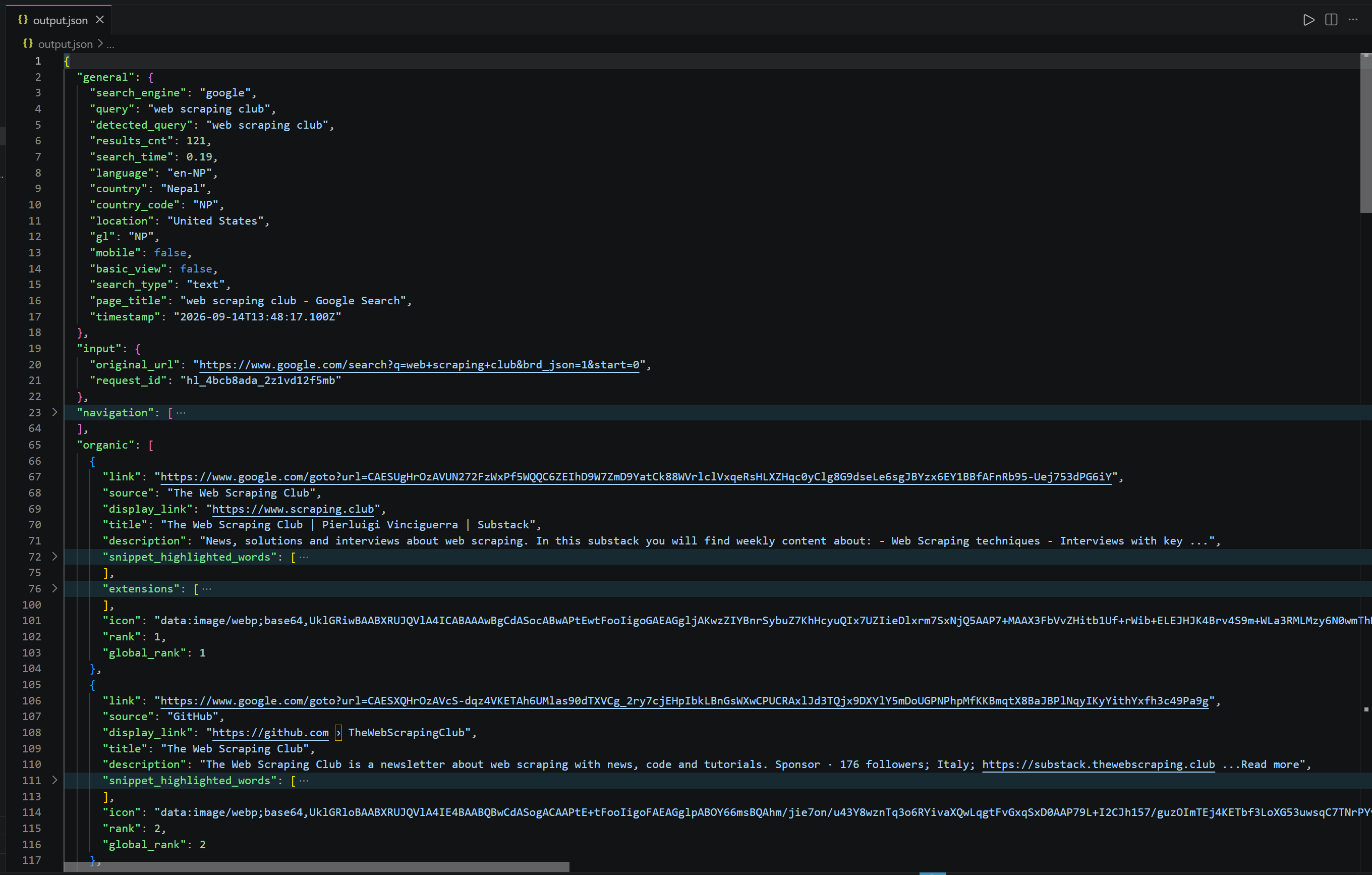
The provider retrieves and returns the search results:The API accesses the target search engine and scrapes the results from it. Depending on the output options, you may receive raw HTML, parsed JSON, LLM-friendly Markdown, or other formats.
One important thing to keep in mind is that a SERP API returns data from a search engine results page. You’ll receive URLs, titles, and snippets, but not the complete text of the underlying pages.
Example output for the “web scraping club” search query using the Bright Data SERP API
This distinction matters in AI workflows. An LLM can use the search results to identify the most relevant URLs and then pass those URLs to another tool that extracts the actual page content, such as a web unblocker. This creates the search-and-extract pattern commonly employed by AI agents for web grounding.
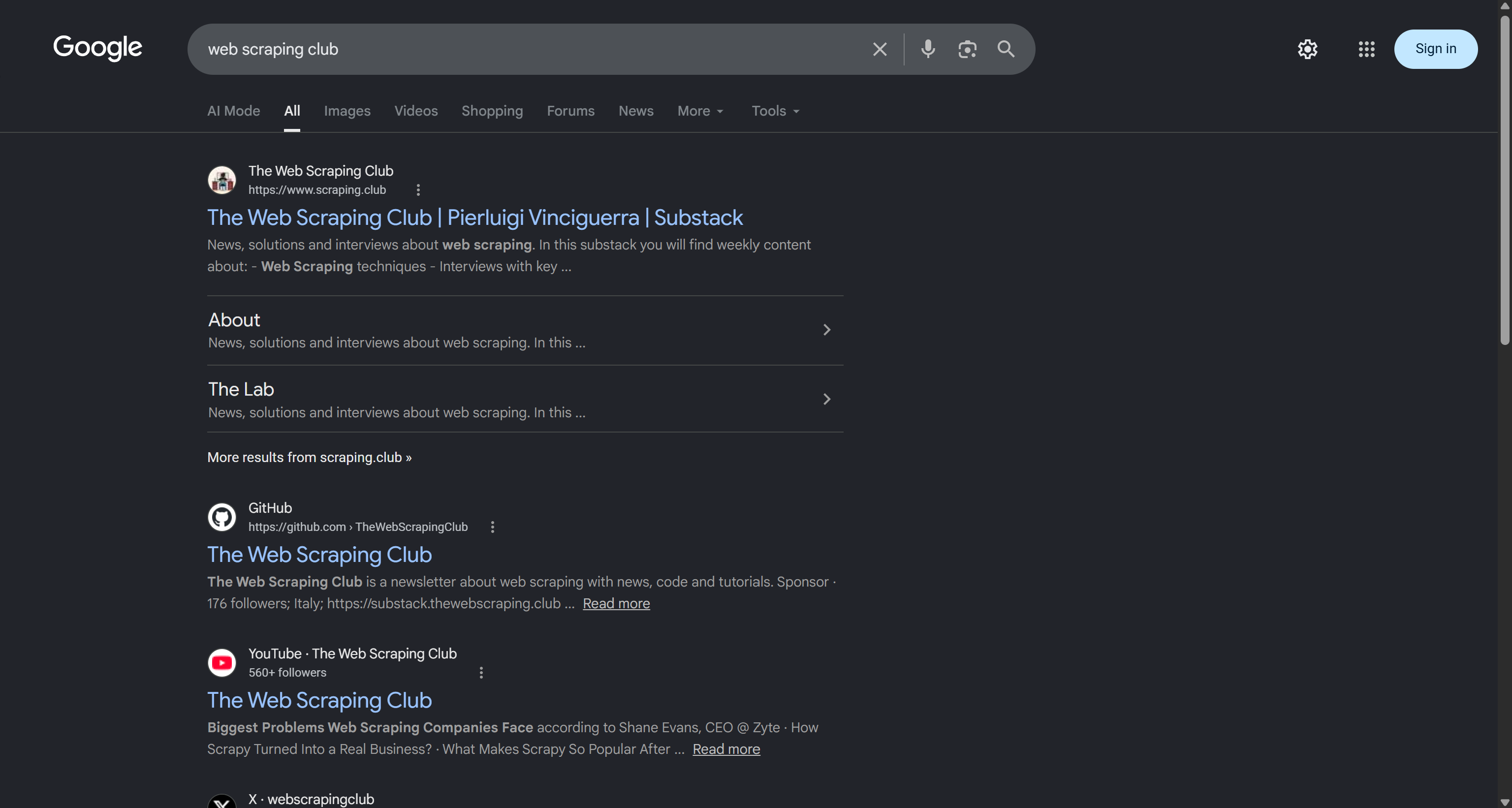
A big advantage of this approach to web search data retrieval is reproducibility. Because you control the search query and parameters, you can reproduce the request by running the same search directly on the target search engine.
Performing the “web scraping club” search directly on Google. The results match those returned by the SERP API
That’s useful for debugging, verification, and compliance. If your pipeline retrieves information through a SERP API, you can also record the exact query, parameters, and timestamp to document what data was retrieved and when.
Web Search API Operations
Web Search APIs usually operate more like a black box. You receive the final output, but the path from your query to those results may not be fully transparent.
The workflow follows these steps:
You submit a search request: You provide a search query, which is typically a natural-language sentence or prompt rather than a traditional, SEO-oriented search query. Depending on the API, you could also specify parameters such as location, language, result type, or latency preferences.
The provider searches one or more sources: The API does its magic and fetches the information you’re looking for.
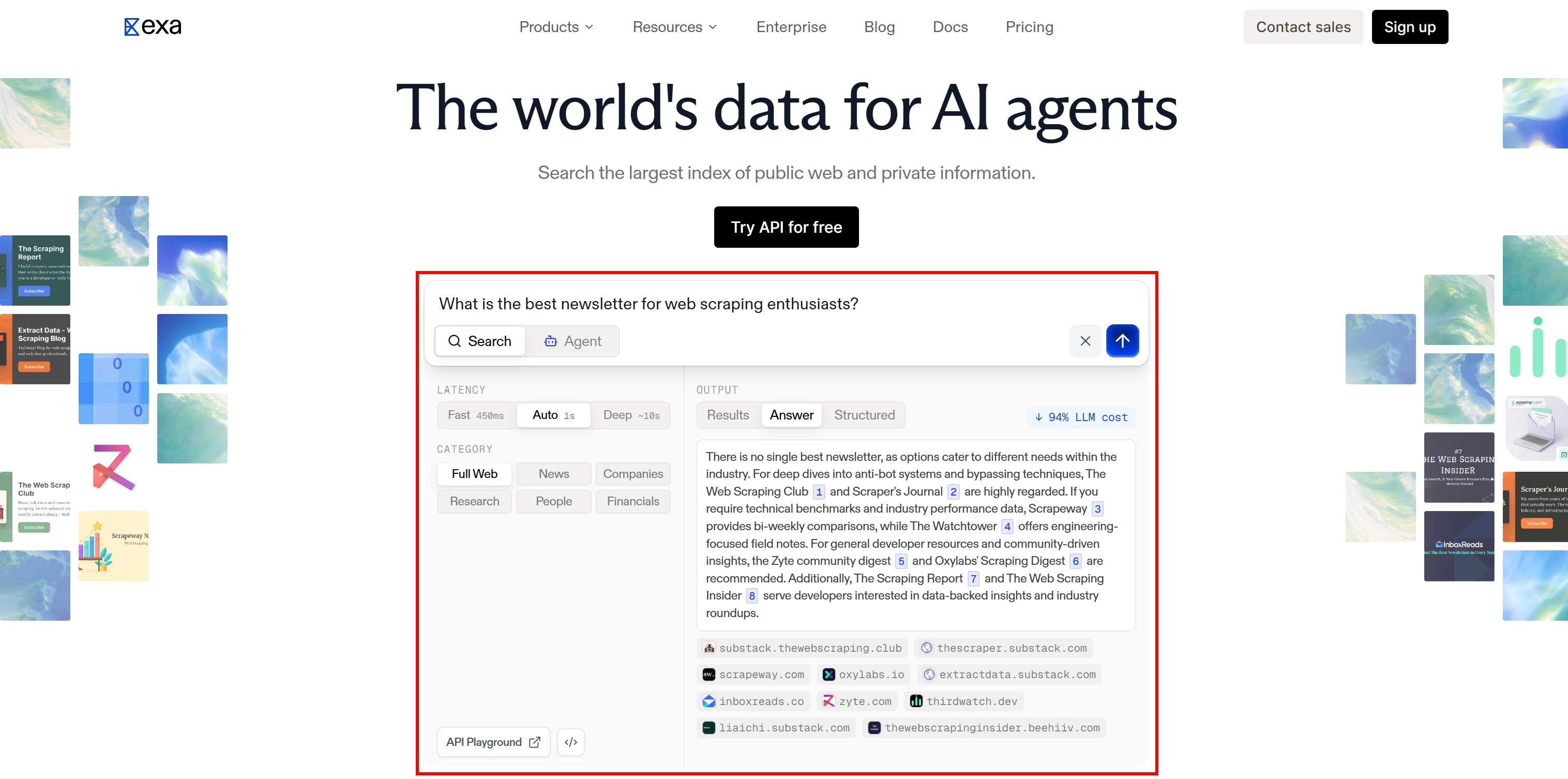
The provider processes and returns the results: It might apply ranking, relevance filtering, content extraction, semantic analysis, or other processing to determine which information is most useful. The final response is returned as structured JSON, Markdown, plain text, summaries, URLs, or a combination of these formats.
Note the textual response from the Exa Search API to a natural-language search prompt
This approach has both advantages and disadvantages. On the positive side, providers can optimize their algorithms and infrastructure without exposing their implementation details. They can also combine multiple sources, apply machine learning to rank results, and tailor the output to AI-powered applications.
The downside is reduced transparency and reproducibility. A web search API can return different results for the same query over time, adding further uncertainty to the already probabilistic nature of LLMs.
Data Sources: Where Do These APIs Get Their Information?
Discover where SERP APIs and web search APIs get their data from.
SERP API Data Sources
SERP APIs retrieve data from identifiable search engines. Common options include Google, Bing, Yandex, Baidu, DuckDuckGo, Naver, Seznam, and Yahoo. As mentioned earlier, some SERP APIs also cover specialized search platforms and verticals, such as product search, news, and social platforms.
The data you retrieve depends on the parameters you provide. Location can greatly affect the results, just like language and device (e.g., a mobile search may return different content from a desktop search). The search type matters as well: organic results, paid ads, featured snippets, knowledge panels, and maps may require different handling.
Web Search API Data Sources
Web search APIs can draw data from multiple sources. Some rely entirely on SERP APIs from different search engines. Others maintain proprietary web indexes built through continuous crawling. More sophisticated solutions tend to combine several approaches, selecting different sources depending on the query.
This flexibility can give web search APIs broader coverage than any single SERP API. They’re not limited by the coverage or limitations of one search engine. Yet, this comes with a trade-off: you generally have less visibility into exactly where each result came from and how it was generated.
Choosing between a SERP API and a web search API ultimately depends on your use case, not on pricing or technical skills.
Prefer a web search API when:
You need real-time information for AI agents and want search results returned in a format they can consume directly.
You require multi-source search without caring which search engine provides each result.
You want direct textual responses rather than raw SERP data, saving you from building your own content extraction pipeline or logic.
Opt for SERP APIs when:
You want SEO or rank-tracking data to monitor keyword positions, competitor visibility, and search engine rankings.
You need reproducible, auditable results and want precise control over the search engine, query, location, language, and other parameters, while being able to document exactly how each result was produced.
You require specific SERP data such as organic results, ads, featured snippets, People Also Ask, knowledge panels, or maps.
The Web Scraping Club is a reader-supported publication. To receive new posts and support my work, consider becoming a free or paid subscriber.
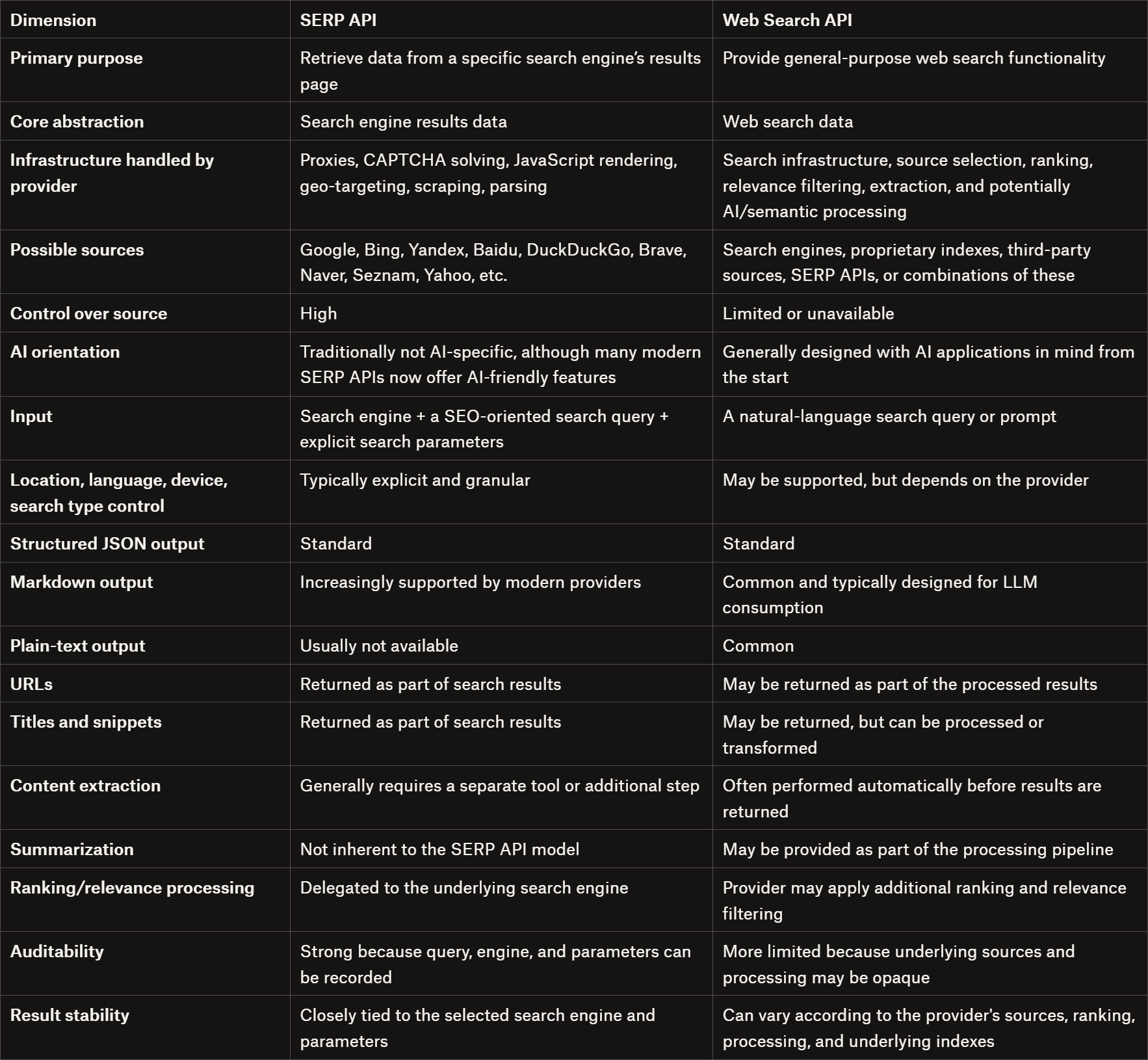
SERP APIs vs. Web Search APIs: Comparison Table
SERP APIs vs. web search APIs: comparison table
Conclusion
Here, I covered what SERP APIs and web search APIs are, how they work, and where they source their data. In particular, you learned that these two types of APIs serve overlapping but distinct purposes.
SERP APIs provide direct and reproducible access to search engine results, while web search APIs abstract away these details and provide search capabilities optimized for AI systems.
Complex applications can end upt using both types of services. SERP APIs can handle specific search engine needs, while web search APIs can power AI-powered search and agent workflows. This hybrid strategy provides the flexibility needed to support diverse, real-world use cases.
I hope you found this post useful. If you have any questions or comments, feel free to leave them below. Thanks for reading, and see you in the next one!
Did you like this article? Share it with someone who might find it useful and get a discount on paid plans.