Can You Scrape Real-Time Market Data for Profitable ML Trading?
Making the case on the challenges associated on scraping financial real-time data, feeding ML models with it, and understanding if you can make profitable bids on financial markets.
So, you’re thinking about scraping real-time financial data, using it to train a machine-learning model, and making profitable trades based on scientific predictions. Sounds like a great plan, right?!
Well, unfortunately, it’s not that easy…Yeah, I know: I’m already delivering bad news, and we haven’t even started yet!
The truth is that collecting real-time market data involves much more than repeatedly retrieving a stock price from a website. And even when you manage to solve that, you still have to deal with the machine-learning part, which is not a walk in the park.
So, yes: scraping real-time financial data to train ML models is possible. But turning that process into reliable and profitable trading decisions is a completely different story.
In this article, I’ll guide you through the main challenges involved in the whole process. Let’s get started!
Give your AI a web data layer – Decodo’s Web Scraping API turns any site into clean, structured data your models can actually use.
Before building a stock market scraper, you need a precise definition of what “real-time” means. The term sounds straightforward, but the reality is that “real-time” means different things in different scenarios (and also in different industries, to be precise).
In finance, data can pass through several systems before reaching your application. This means that a price displayed on a website may already be seconds - or even minutes - behind the event that occurred at an exchange.
What “Real-Time” Actually Means
Let’s specifically focus only on financial data. In this context, real-time data is updated live in a time interval that is as close as possible to the moment an exchange processes a financial event. A typical example is the live value of a stock price.
On the other hand, delayed data is intentionally published after a fixed interval. Depending on the source and market, the delay may be several minutes or longer. Delayed data is useful for educational tools, historical analysis, and applications that don’t support immediate decisions. And note that the same financial exchange reports both the live value of a financial index and its historical value.
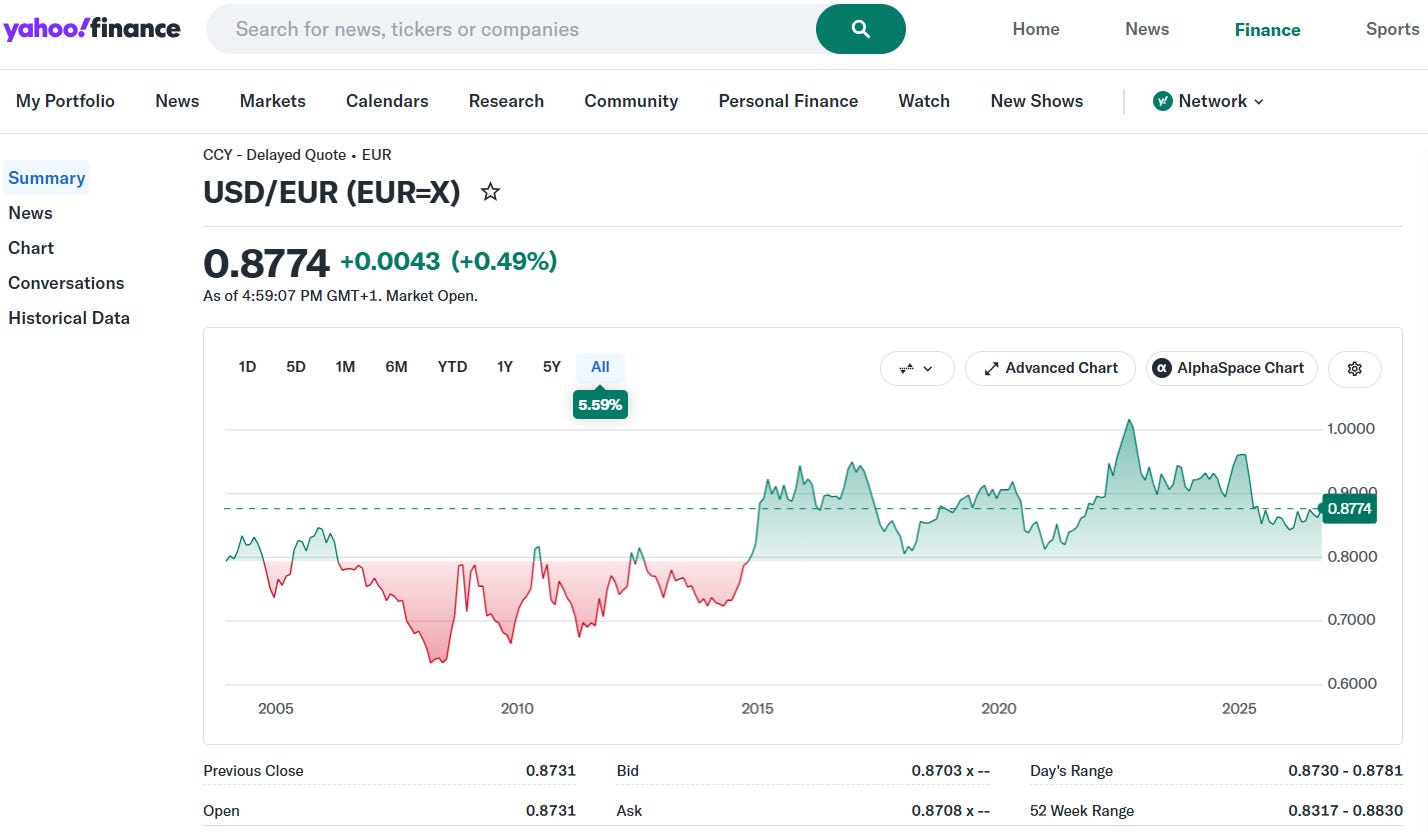
A common example is the USD/EUR daily rate. The currency exchange values change over time, just like stock prices do:
USD/EUR exchange value live.
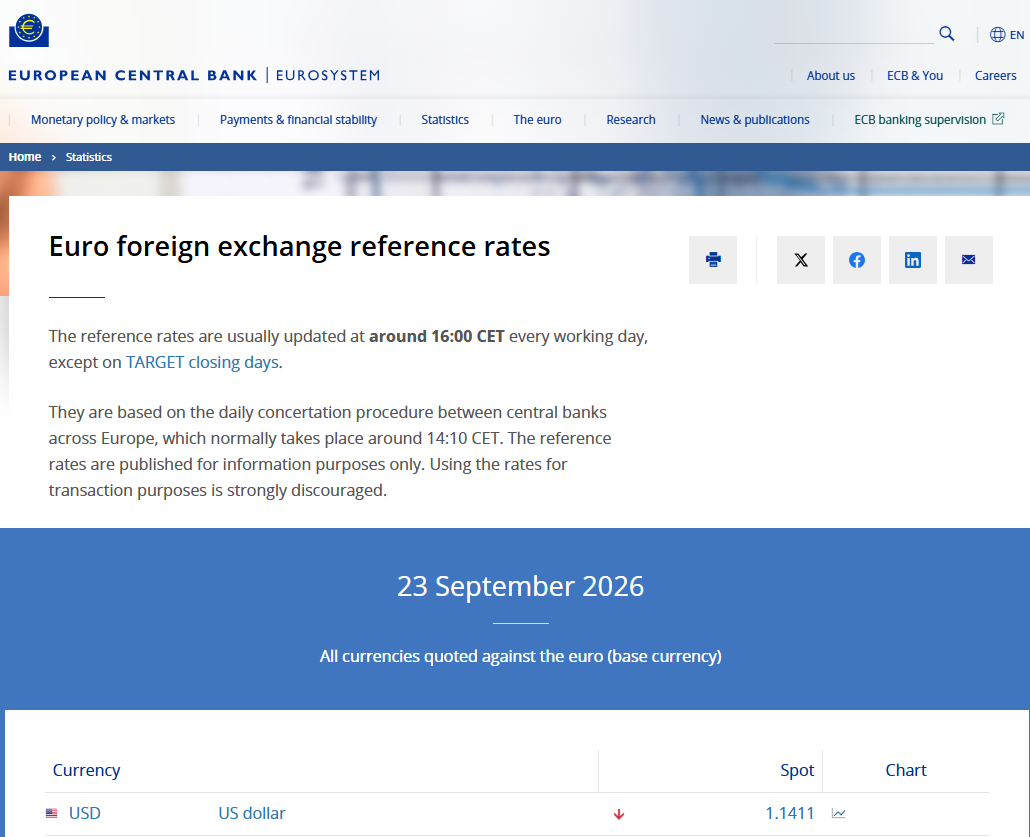
However, if you are a freelancer and need to send an invoice in USD to your client, but your government wants it in EUR because you’re in Europe, then you’ll need to refer to the daily rate. Every day, the European Central Bank defines the daily USD/EUR exchange rate, and publishes it on its website at a fixed and predefined hour (and so do Yahoo Finance and the other providers):
EUR vs. reference exchanges' daily rates.
So that is the distinction between real-time and historical data. But there’s another category that falls between those two: near-real-time. This kind of data arrives quickly enough for dashboards, monitoring, and many analytical workloads, yet it doesn’t guarantee immediate delivery. For example, a scraper polling a financial website every ten seconds can only capture changes after the website publishes them and the next request runs.
Tired of getting blocked while scraping the web? ScrapingBee handles proxies, browsers, anti-bot systems, and retries so you can focus on your data. Get clean Markdown, JSON, or HTML from the web with up to a 99.9% success rate. ScrapingBee is SOC 2 Type II and GDPR compliant, and trusted by 4,000+ developers.
So, the line of differentiation between real-time and near-real-time is very fine. Also, note that this distinction can be affected simply by total latency. In other words, an exchange’s publication delay, vendor processing, network transmission, your scraping interval, parsing, queueing, and database writes affect the total time it takes for data to “travel” from source to storage or visualization. Which means two things:
Increasing the scraping frequency won’t eliminate latency that already exists upstream.
The line between actual real-time data and near-real-time often depends on things you can’t manage.
As a final consideration, note that you’ll encounter inconsistent terminology. For instance, exchanges may define real-time according to feed-distribution rules, while brokers may focus on what customers see in their trading interfaces. Financial websites sometimes label a page “live” even when updates are delayed, cached, or refreshed periodically.
Overall, as you can understand, the concept of “real-time”, “near real-time” and “delayed time” is tied to your specific use case, but it also depends on conditions you often can’t manage.
Common Data Types and Use Cases
Regarding the “real-time” thing, you also have to consider that financial markets include more than just the latest traded price:
Trade records describe completed transactions.
Quotes contain available bid and ask prices.
Order books show buy and sell interest across multiple price levels.
Other useful inputs include trading volume, market indices, corporate actions such as dividends and stock splits, and time-sensitive financial news.
This means that different applications require different levels of freshness. For example:
A public dashboard may tolerate updates every few seconds or minutes.
A price alert needs sufficiently frequent collection to detect a threshold crossing before the information becomes irrelevant.
A machine-learning prediction system may require synchronized, high-frequency observations from several sources.
In other words, your scraping architecture should follow the actual use case you need. So, don’t begin by scraping as quickly as possible. First define the acceptable latency, required history, and reliability target; then design the collection pipeline around them.
Evaluating Sources, Access Methods, and Constraints
Choosing a market-data source isn’t simply a matter of finding a page that displays the right number. If you want to scrape financial data, you have to compare public websites with official APIs, broker endpoints, commercial data vendors, and direct exchange feeds to be as precise as possible.
This is because each option provides a different balance of freshness, reliability, complexity, cost, and permitted use. And you need to account for those before deciding the path you want to pursue when scraping their data.
Reliable access is the foundation of any scraping project. IPRoyal offers 64M+ residential IPs to help you reach any website without blocks or bans.
Choosing Between Directly Scraping Websites or Using Their APIs
Public financial websites are a common starting point for scraping real-time financial data. Indeed, their pages expose prices through rendered HTML, embedded JSON, background HTTP requests, or streaming connections. The trade-off is the same you already know if you’ve been scraping for a while: page structures can change without warning, fields may disappear, and anti-automation controls can interrupt retrieval.
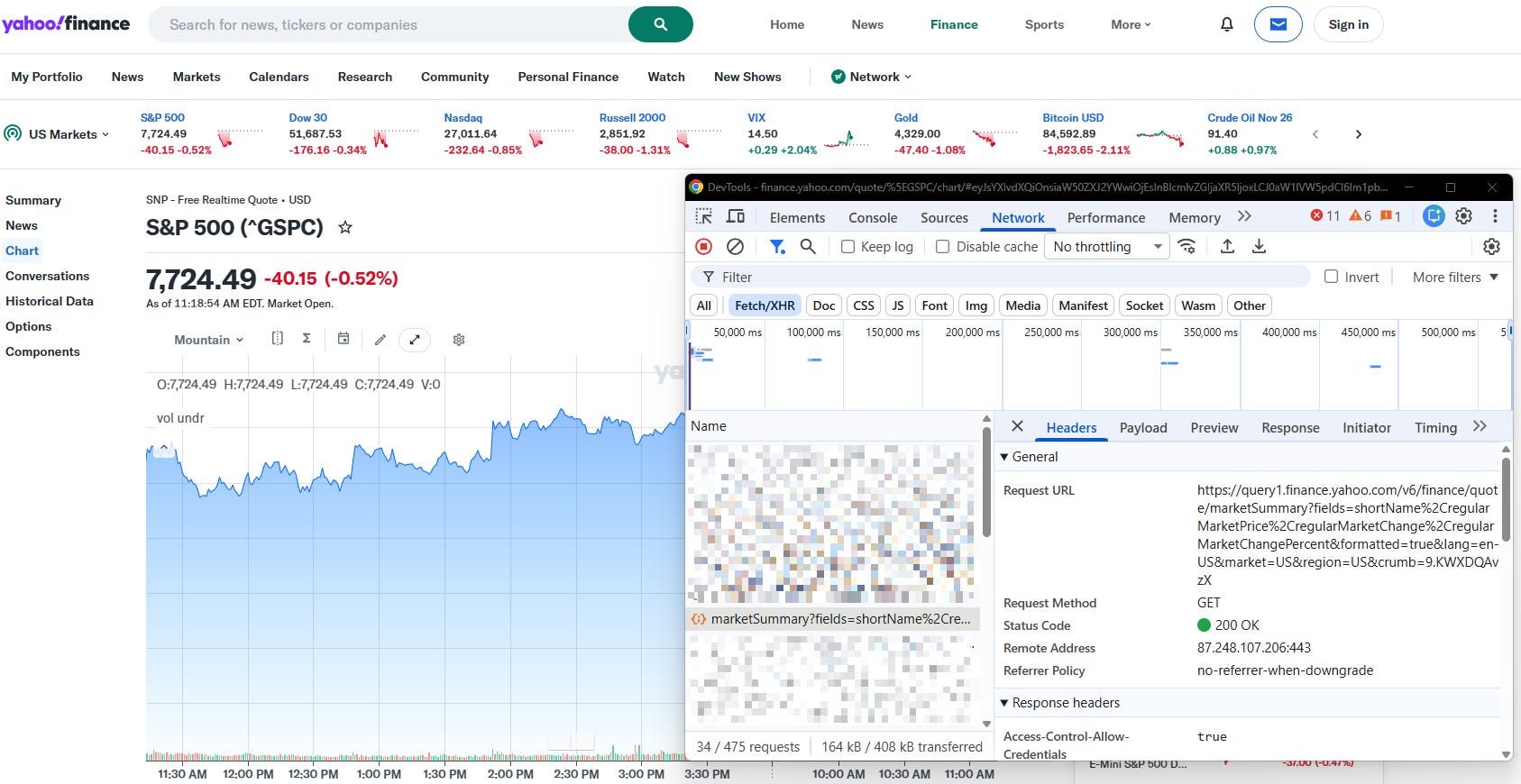
Now, if you’ve been scraping for a while, I bet that your first thought is to start by inspecting the target page. If that’s so, I have bad news for you. This (common) procedure is probably the hardest thing to do when it comes to scraping real-time data. This is because often real-time data is rendered via internal requests that you can not intercept. Here is an example from Yahoo Finance:
Graphs are displayed from internal requests on Yahoo Finance.
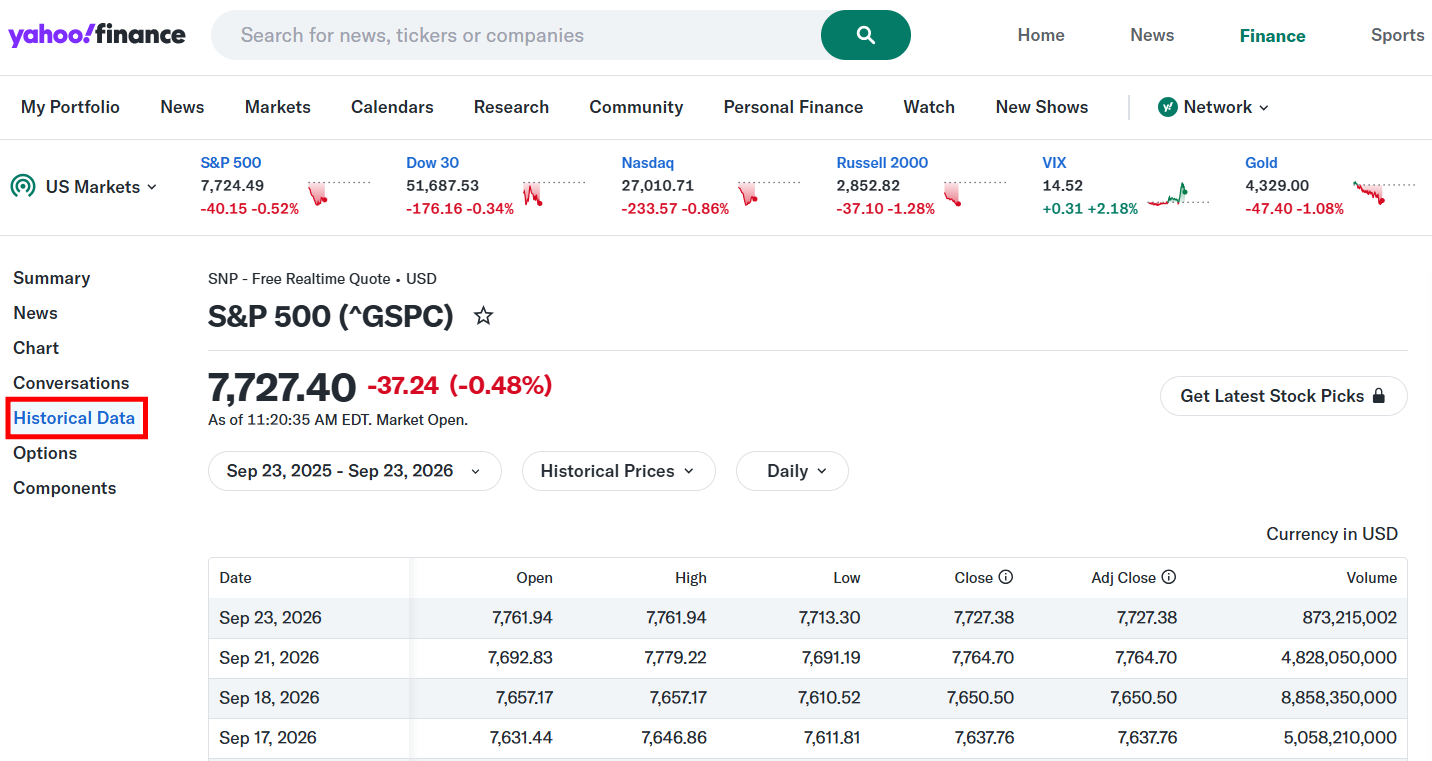
On the other hand, historical data are always presented in tables, so they’re easier to retrieve:
Historical data on Yahoo Finance.
For this reason, another scraping option you have is websites’ official APIs (hopefully, well-documented…). This makes them generally more stable - when they exist - than scraping the rendered HTML. The downside is that APIs may impose request quotas, restrict historical access, provide delayed data under lower subscription tiers, and ask you to pay for a monthly subscription or per request.
So, when comparing data sources, you should assess at least the following six characteristics, instead of rushing for “the best scraping method”:
Latency: How much time passes between a market event and its availability from the source?
Coverage: Which exchanges, securities, fields, trading sessions, and historical periods are included?
Reliability: Does the source provide consistent availability, ordering, timestamps, and recovery after interruptions?
Documentation: Are schemas, status codes, limits, and update policies explained clearly?
Authentication: Does access require API keys, account credentials, tokens, or market-data entitlements?
Long-term stability: Is the interface versioned, supported, and likely to remain available?
And what’s important to bear in mind is that visible real-time prices on a website may differ from the prices you get via the APIs. The technical scenarios under the hood are mainly the following two:
A website dashboard might update through a dedicated streaming channel, while its public API returns cached or delayed values.
Conversely, an API may provide fresher structured records while the browser displays a throttled view.
This means that, unfortunately, you can’t always trust what you see, when you are making a comparison between what a website displays on its dashboard and what its API returns. So, what you should do is validate each interface independently, and choose one depending on the characteristics listed above. This is because being consistent (using the same source) is more important than understanding which of the two sources reports data that is “more real-time” than the other (when the temporal difference matters, of course).
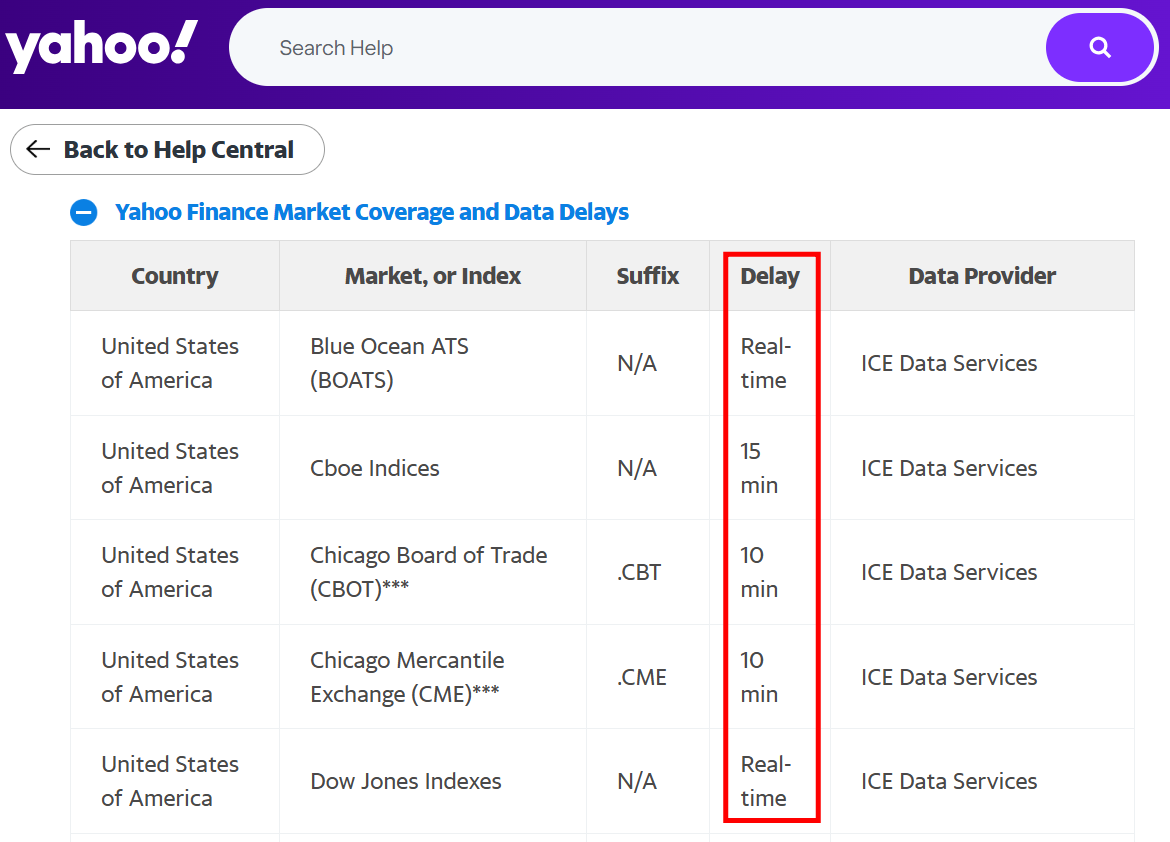
As an example, the following image shows a table from Yahoo Finance reporting the timing they display the data in their UI’s dashboards:
Yahoo Finance’s declared data delay.
So, just because you see indexes displayed on a website, you can’t assume they’re always in real-time.
Legal, Licensing, and Operational Boundaries
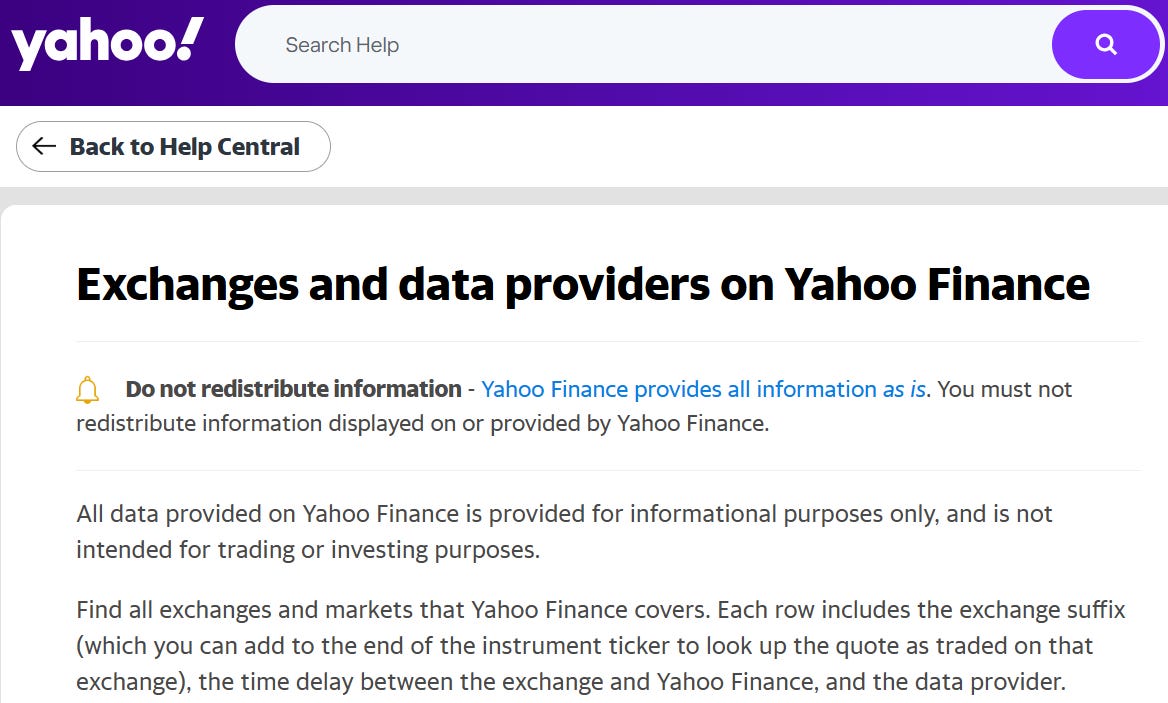
Another thing to do before scraping is reviewing the source’s terms of service, exchange licensing conditions, attribution requirements, and restrictions on storage and redistribution. This is because market data can carry contractual and licensing obligations even when it appears on a publicly accessible page. Some providers permit personal viewing but restrict automated collection, commercial use, model training, or republishing. For example, below is Yahoo Finance’s data disclaimer:
Yahoo Finance’s data disclaimer.
You should also inspect the site’s robots.txt file. As largely discussed in our article “Understanding robots.txt and its Implications”, while it isn’t a statement of legal permission, you should strive to respect its directives if you want to be at least compliant. You know, just in case you need to respond to a judge…
Rate limits require similar attention too, because you don’t want to overload the servers and get banned by anti-bots. For the sake of scraping data in real-time, it’s easy to get carried away out of fear of losing data at any moment. Generally speaking, published limits appear in API documentation or website terms of service. But if no limit is publicly stated, that doesn’t mean you can send unlimited requests. The general idea is to always scrape ethically, and to do so, use conservative request frequencies, apply async scraping best practices, cache responses where appropriate, apply backoff after errors, and avoid bypassing authentication.
Finally, verify permission before building your scraper, because accessibility and public availability aren’t the same as authorization. In other words, data being visible on a browser doesn’t automatically make unrestricted scraping, storage, redistribution, or commercial reuse acceptable.
Challenges in Storing Real-Time and Near-Real-Time Data
When scraping financial data in real-time, collecting stock prices frequently is only one of the challenges. Another one is that your system must also store incoming records without losing events, creating uncontrolled duplication, or slowing down as the dataset grows.
This means that there are several engineering considerations to make and decisions you have to take before starting to scrape regarding your infrastructure. And as with any technical decision, the right one depends heavily on the scenario that suits your case. Specifically speaking for financial data, the main decision revolves around whether you need to preserve every market event or maintain only the latest known state.
Storage Challenges and Data Modeling Challenges
If you’ve never dealt with financial data, you’ll soon discover that frequent market updates generate a surprisingly high write volume in databases. That’s easy to see if you think of the underlying processes: if a scraper records several observations per second, the database must continuously process inserts while supporting queries, validation, and downstream analysis.
And of course, adding more data sources compounds the problem, because each source may publish its own version of the same event. In such scenarios, storing duplicate observations is very common. However, note that removing duplicates based only on price is unsafe because multiple legitimate trades can occur at the same price. The practical implication of this is that reliable deduplication usually requires at least a source-provided event identifier. In a nutshell, only accounting for deduplication is a hard engineering job.
But that’s not everything…
For genuinely real-time ingestion, a streaming platform is generally a better foundation than writing every message directly into a relational database. This is because streaming systems are designed to accept continuous event flows, preserve ordering within defined partitions, buffer traffic spikes, and allow multiple consumers to process the same data independently. This way, if a database temporarily slows down, the stream can retain events in the correct temporal order.
Of course, that doesn’t mean streaming platforms replace relational databases. A stream system is the ingestion and transport layer, while relational systems provide the queryable storage. The point here is that if you need to scrape real-time data, chances are that you’ll have to use a streaming platform as the ingestion layer. And if you’ve never dealt with them, believe me: the technicalities under the hood are quite a lot (but there are specialized people on the market that can help you, right?!).
Retention and Performance Challenges
Data storage is important, but storing every raw tick forever is rarely practical, especially when focusing on real-time data. In such cases, a tiered retention policy lets you preserve the necessary detail while controlling cost. The main applicable ideas you can take into account as guidance are the following:
Recent raw ticks might remain in fast storage for debugging and immediate analysis.
Daily summaries may remain available indefinitely.
This means that, to preserve storage (and cost), historical archives should preserve the source data, schema version, transformation logic, and correction history needed to rebuild derived datasets. Nothing more.
Since you’re focusing on real-time data, there are two specific ingestion situations you have to account for when managing storage:
Late-arriving: These are events that reach your pipeline later than the expected delivery window. This may happen because of network latency, retries, buffering, source outages, or slow processing. For example, a trade executed at 10:00:05 might not reach your system until 10:01:10, after the corresponding one-minute aggregate has already been calculated.
Out-of-order events: These are events that arrive in a different sequence from the one in which they occurred. For example, an event from 10:00:08 may reach your pipeline before an event from 10:00:06. This can happen when records travel through different network paths, are processed by parallel workers, or are retried after a failure.
These two kinds of occurrences create another design decision because network delays, retries, buffering, and source corrections can cause an older event to arrive after newer ones. Event-time processing can place it in the correct historical position, but previously calculated minute bars may already be published. In such cases, you have to define a logic that allows your pipeline to decide whether to correct those aggregates, issue a new version, or preserve the original result with a quality warning.
Note that near-real-time architectures simplify many of these problems by accepting a small, controlled delay. In this model, records can be buffered briefly, validated together, reordered by event time, deduplicated, and written in batches. Recovery is also easier because failed batches can be retried without coordinating every individual event.
So, the practical thing to bear in mind is that lower latency always has a cost. If an application can tolerate updates every few seconds or minutes, near-real-time processing may deliver better reliability, simpler operations, and lower storage overhead than a fully streaming design. In other words, you must define the required freshness first (what actually “real-time data” means for your case), then choose the least complex architecture that consistently meets it.
Challenges in Training Machine-Learning Models on Real-Time Financial Data
All right, let’s say you finalized everything. You decided what “real-time” means for you, defined the data model and the data storage, and you were also able to retrieve the financial data you want. And you’re also pretty happy with the process!
Well, unfortunately, the relationship between real-time data and profitable predictions isn’t so straightforward…Yeah, other bad news, sorry about that!
Having access to a continuous stream of market data only solves the data acquisition problem. You still need to create a reliable training dataset, validate the machine learning model, and reproduce the same process in production. And even if the model predicts prices accurately, its signals may not remain profitable after accounting for the practical costs of executing trades.
Let me guide you through the challenges of this part of the process that may follow the data acquisition one.
Building a Reliable Training Dataset
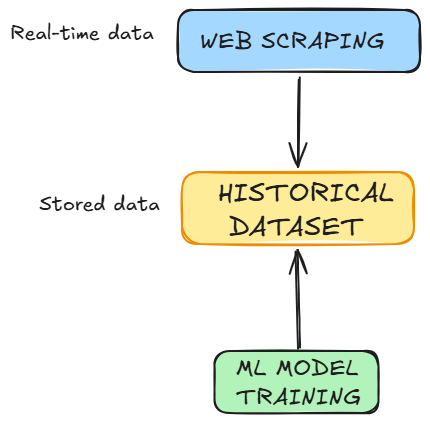
The first problem is the real-time pipeline itself. Basically, what we discussed so far in this article is the foundation for creating your dataset of historical data. But don’t let the confusion get you here: you need to work on real-time data while scraping to create an historical dataset to train an ML model that’s able to predict future values:
Historical datasets are made of real-time data.
In this case, you create a dataset out of real-time data. So, the real-time data becomes historical because it is stored. But for the model, they represent the value in each recorded time interval. In other words, the ML model learns to predict real-time values from historical data. And there’s no way you can do it differently.
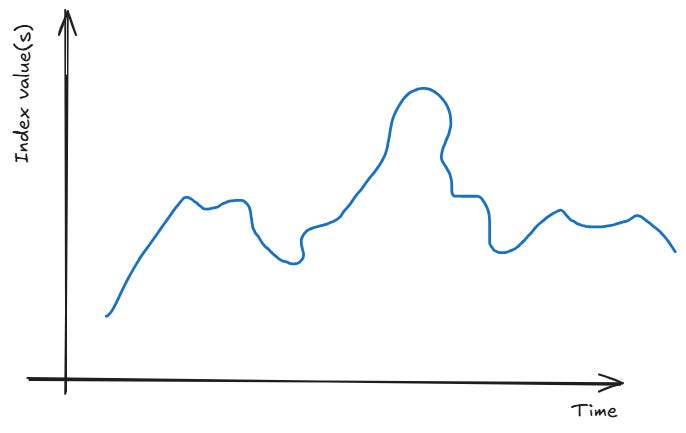
Creating a historical dataset with occurrences that change over time means dealing with time-series analytics:
A representation of data occurrences that change over time.
But time-series modeling introduces another set of difficulties. Most standard machine learning workflows assume that observations are independent and that the relationship between input features (aka, what happens at a company, etc…) and targets (aka, companies’ stock prices, and any data associated with it) remains reasonably stable. However, financial time series rarely satisfy those assumptions. This is because prices, returns, volatility, and trading volume are temporally dependent, while their statistical properties can change as market conditions evolve.
Mathematically speaking, this means that a pattern learned during a low-volatility period may disappear when volatility increases. So, in that case, the ML model learned an exception instead of something general, and this will likely make it mistake future values.
So, apart from all the technical difficulties you’ve learned so far, there is one that is intrinsic to the ML industry applied to financial data - and that’s a big one.
Defining What the Model Should Predict
The prediction target also requires careful definition. “Predict the price” isn’t precise enough for a machine learning model. You need to specify which price you want to predict, at what future horizon, and relative to which reference value. For example, predicting the next recorded trade is different from predicting the midpoint between the best bid and ask five minutes into the future.
This choice directly affects the dataset and the usefulness of the result. An ML model can correctly predict that the price will increase while failing to estimate whether the movement will be large enough to cover the bid-ask spread. So, note that predictive accuracy and trading profitability aren’t equivalent measures.
Evaluating the Model Without Future Information
Model evaluation is equally delicate, because financial models should be evaluated chronologically. A typical procedure trains the model on an initial period, tests it on the next period, and then moves the training and testing windows forward.
This approach is closer to how the model would operate in production. However, even this method must account for overlapping prediction horizons and features whose calculations include rolling windows, as those can still introduce leakage near the boundaries between datasets.
Running the Model in Production
Finally, after training is successful, you have to deploy the ML model to production so that it can make predictions based on real-time data, the moment they’re ingested.
Technically speaking, this means that incoming records must be transformed into features using exactly the same definitions applied during training. Also, the production system must monitor feature freshness, missing inputs, inference latency, prediction distributions, and realized performance.
Without going deep into details, if you’ve ever dealt with pushing software to production, you understand the challenges under the hood. And when it comes to pushing ML models to production, the challenges increase even more.
Finally, as market conditions change and time goes by, every ML model requires recalibration or retraining. In other words, from time to time, you need to restart the whole process from the beginning…so, let me wish you good luck!
The Web Scraping Club is a reader-supported publication. To receive new posts and support my work, consider becoming a free or paid subscriber.
Conclusion
Overall, in this article I wanted to share the difficulties associated with scraping real-time financial data, especially if your goal is to train ML models to predict where the market is going - and eventually get some profits.
Don’t get me wrong: I’m not saying that you should not try. I wanted the message of this article to be this one: It’s very hard to put the pipeline in place, and it’s very unlikely that you’ll get good results in terms of financial satisfaction.
So, let’s discuss in the comments: Have you ever thought of scraping real-time financial data to train ML models? Have you ever tried it, other than just thinking of it?
Did you like this article? Share it with someone who might find it useful and get a discount on paid plans.