

In any human field, people are pushed to act according to incentives.
If in a company we measure the productivity of developers by the number of lines of code written, and we add an economic incentive to this (more lines, more money), sooner or later we’ll see huge repositories, with more and more lines and no push to optimize. In the same way, if we tie the incentive to the number of commits, every small change to the codebase will become a commit. Developers will look more productive according to the metric, but not according to reality.
Give your AI a web data layer – Decodo’s Web Data API turns any site into clean, structured data your models can actually use.

This principle also applies to the agentic web and to scraping.
Here the incentives are opposed: on one side there are those who want to use automation (browser automation in general, or agents), on the other side there are the website owners.
Let’s take the case of a content creator, like me. For sure, I prefer that my articles are read by humans. First of all, because they appreciate what I say. And then, because the newsletter is sponsored, a human reader can see who supports it and which services they offer. This is the service I give to the sponsors. Without it, they would stop supporting the newsletter, and the newsletter itself would risk disappearing.
Those who read the newsletter with agents or other automatic tools, instead, often have another need: building an internal knowledge base, having summaries of the articles to read later on other platforms, or feeding an internal news search tool. In this kind of reading, nobody sees the sponsor.
This also applies to e-commerce, of course. There are several cases of agents that want to buy tickets or items on behalf of humans. At the same time, the e-commerce platform doesn’t want an agent to make this kind of purchase on its own, mainly for two reasons. The first one is that it doesn’t want to lose the user who browses the catalog and changes their mind. The second one, and the most important, is cybersecurity: enabling a bot to perform actions like purchases on a website risks being an open door to fraud or to automatic bots of other kinds.
Today there is a lot of discussion about how AI agents should authenticate themselves on the web, and in my opinion the discussion starts from the wrong question. Everybody asks which protocol to use. In this article, we look at a different question: which incentive does the company that builds an agent have to use one? We start from a recent case, the one of Muse, then we reason about the incentives of those who build agents, and at the end we read the protocols on the table with this lens.
Datafuel is The Fuel for Web Scraping & AI Agents, with proxies and scraping APIs.

The Muse case
On September 20, 2026, Amazon started blocking Muse, the AI agent of Meta. The reasons Amazon gave to the press, as reported by GeekWire, are three: Meta didn’t tell Amazon that the agent was going to access the store, the agent doesn’t identify itself when it browses, and it seems to capture and store the credentials of the customers.
The second reason is the one that helps us better understand the tension between the two different interests. In fact, according to the analysis of Cequence, a bot protection vendor, Muse uses a real Chrome browser in the cloud and a consumer VPN to look like a real user. It looks almost like a professional web scraping setup.
Amazon is not the only website that reacted. Jefferies tested Muse on several hundred websites and found three groups of similar size: one third blocked the agent, one third challenged or limited it, and one third was easy to use.
But why use this kind of setup? To have an answer, let’s go back to the topic of incentives.
Incentives decide the behavior
The principle of the introduction applies here too: once the incentives are set, everything aligns to reach them.
In web scraping, the incentive is to get the data. Whoever writes the scraper is paid by a customer or by their own company, and is paid when the data arrives, at the lowest possible cost. So they will do everything they can (inside the limits of the law, of course) to reach the data.
For agents, it works in the same way. The promise of an agent is that it can do on the web everything a human can do, with the accounts of that human. This means that the incentive of whoever builds the agent is that the agent is never blocked by the policies of a website. If the agent is blocked, the human behind it can’t complete the action, and the product doesn’t work.
A human can go everywhere on the web, so an agent that can go only where it’s allowed is a smaller product.
Two roads to avoid the block
If the goal is to never be blocked, I see two roads.
The first one is to be indistinguishable from a human. It’s the road that comes from the scraping world: a real browser, clean IPs, a coherent fingerprint, timings similar to the human ones. It costs in infrastructure, and it requires maintenance, because anti-bot vendors update their detection. Muse took this road.
The second one is to authenticate. The agent declares what it is with an identity that the website can verify. On the technical side it costs very little, but it leaves the decision to someone else: it’s the website that decides if you can enter and what you can do there.
The Muse case shows that the block works in both directions. If you identify yourself, the website has a simple way to block you. But if you dress up as a normal user and you do it badly, you get blocked anyway: two-thirds of the websites in the Jefferies test blocked or limited an agent designed to look like a human.
So the choice between the two roads is a comparison. How much does it cost to be invisible, and how many times does it work? What do I get if I authenticate, and how many times does the website say yes? A protocol gets adopted when the second road pays more than the first one.
The same math of Pay per Crawl
We have already seen this comparison in web scraping, with Pay per Crawl by Cloudflare. I wrote about it in August 2025, so I’ll keep it short here.
On paper, Pay per Crawl is an interesting idea, and above all it’s a concrete proposal to solve the problem of the commercialization of online content and of its remuneration. I’m not surprised that it was welcomed very well, especially by news publishers, who are the first to suffer from the lack of remuneration of online content.
But what does the company that scrapes get? It has to identify itself, pay the price set by the website, and accept that the website can say no. On the other road, it can use a web unblocker and pay per request, without asking anyone for anything. As long as the second option works and costs less, a scraper has no reason to enter the protocol. More than one year after the launch, the Cloudflare documentation still describes Pay per Crawl as a closed beta, and I haven’t found public numbers about its adoption.
Who is accessing the website?
There is also a legal side that pushes in the same direction. Amazon sued Perplexity in November 2025 for its Comet browser, with an accusation very similar to the one against Muse: the agent presented itself as a normal Chrome session. In March 2026 a district judge blocked Comet from shopping on Amazon. On August 4, the Ninth Circuit cancelled that order. The reasoning is that, when a user gives the assistant a task to complete on Amazon, it’s the user who accesses the computers of Amazon.
I want to be clear about one caveat: this decision is only about the preliminary order. The case is still open, Amazon has filed an amended complaint and, while I’m writing, there is a motion to dismiss pending.
But think about how a product team reads this decision. If the agent is the user, why should it present itself as something different from the user?
What does the agent get from each protocol?
With this question in mind, we can read the protocols on the table. I split them into two families: the ones that identify an agent that reads, and the ones that identify an agent that pays.
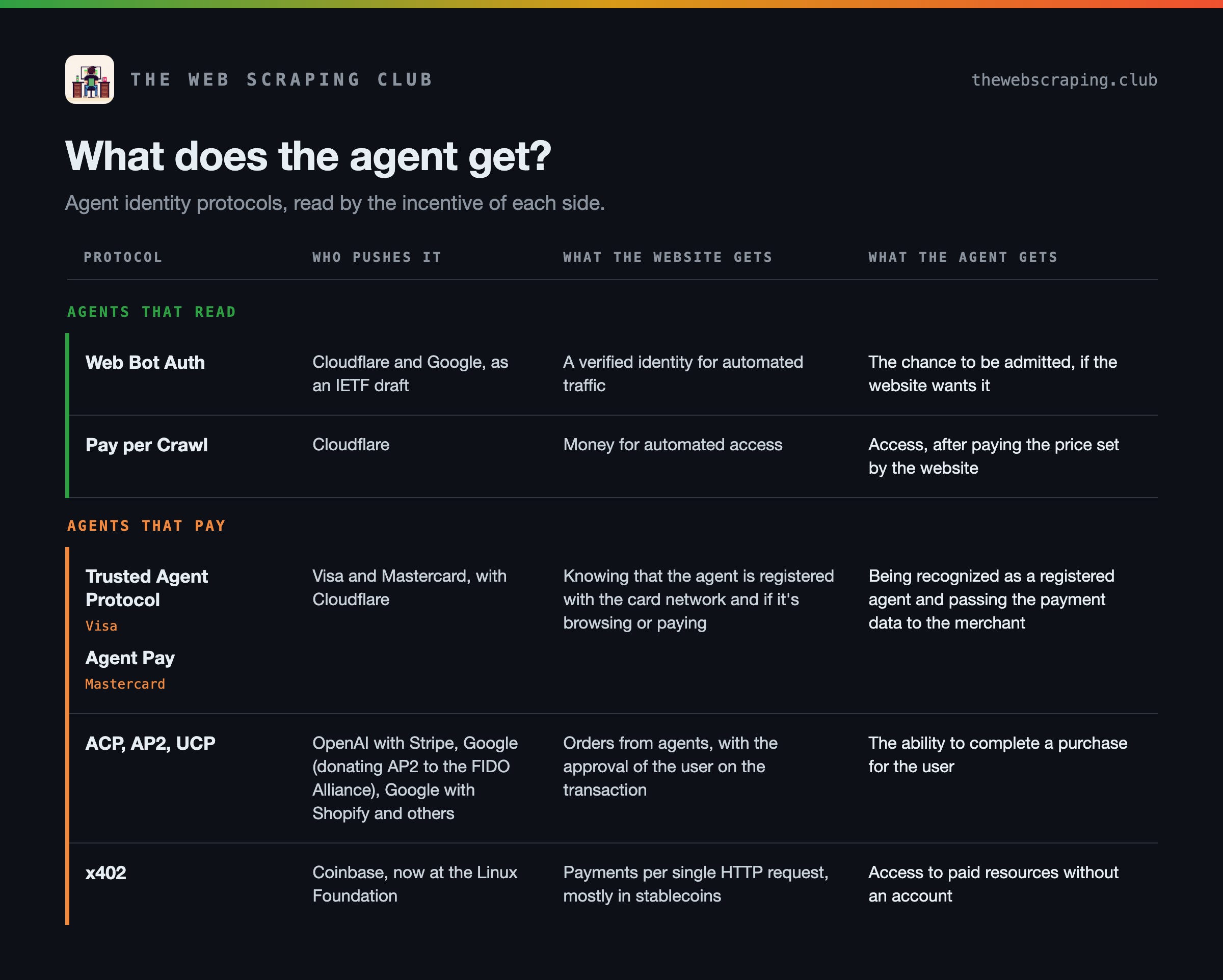
Web Bot Auth is the base of the first family. The agent signs its HTTP requests with a private key and publishes the public key in a directory, so the website can verify who is sending the request. The draft is honest about its own limits. A valid signature proves that the request comes from whoever holds a key published at that address, and it lets the website understand that it’s dealing with the same party as before. The text says that the signature says nothing about who operates the agent, whether the agent is benign, or whether the request is authorized: these are decisions of the website.
Some agents already sign their requests. Cloudflare listed ChatGPT agent, Goose by Block, Browserbase and Anchor Browser in its first group of signed agents, and Amazon Bedrock AgentCore Browser adopted the protocol too. Cloudflare also writes that its Browser Rendering product sends signed headers and always receives a bot score of 1 (on the Cloudflare scale, 1 means that the request is certainly automated). So a signed agent is recognized as automated, and what happens after depends on the rules of the website.
Now let’s look at the Trusted Agent Protocol by Visa. Cloudflare explains that Visa and Mastercard built their protocols on top of Web Bot Auth, adding a tag that says if the agent is browsing or paying. The signature is the same as in the first family. What changes is what the agent receives in exchange.
Shopping agents and agents that read
It’s here that, in my opinion, the two families split. An agent that only collects information gets nothing from authentication that it can’t have as an anonymous browser. The page is the same. The website, on its side, earns nothing from the visit: as Digiday describes, an agent reads the content without generating an ad impression. So the website has reasons to block or to get paid, and the agent has reasons to hide. We go back to detection against evasion, the game we know from scraping.
It’s the case of the newsletter I described at the beginning. Whoever reads it with an agent to fill their own knowledge base has nothing to gain from declaring it, and I have nothing to offer them in exchange for their identity.
A shopping agent is in a different position, because at the end of the session there is a payment. The merchant wants the sale. The card network wants the transaction to be safe. The agent needs something it can’t fake by looking human: a payment that the issuer accepts as authorized by the user. If attested payments are enabled only for the agents that authenticate as agents, then authentication becomes the way to complete the task, and the incentive of whoever builds the agent points to the protocol.
This could be the keystone. The card networks are working on it: Visa says that more than 175 issuers in 45 markets joined its Agentic Ready program, Google announced the donation of AP2 to the FIDO Alliance in April, and the x402 Foundation became operational in July with forty organizations. These are announcements of the companies involved. I haven’t found independent data on how many merchants are live.
The interests of the two parties must be aligned
To recap, for a protocol to be used, the interests of both parties must be aligned. Whoever has to declare the agent inside that protocol must have something in exchange: in the case of shopping agents, basically the ability to pay without being blocked. The website, on its side, must be sure that the protocol can’t be abused and that it brings more sales than not having it.
At this point the decisive factor becomes the adoption of shopping agents by the final users. If the demand for purchases through agents keeps growing, websites will have to define a strategy to accept payments from agents, even at the cost of having less human traffic. For those who sell, the economic transaction still happens on their own website, and this compensates in part for the loss of visits.
Then the race will be to get chosen by the agent, like it happens today for SEO or for voice assistants like Alexa, when we ask it to buy batteries for us on Amazon. This too is about incentives. With its voice assistant, Amazon has every incentive to propose first the white label products it sells. We need to understand if those who create these agents will have an incentive to push certain products to be accepted on Amazon or on other websites.
Amazon knows this race well. It has its own shopping assistant, Rufus, and a count from November found 99 crawlers and agents named in its robots.txt, including ChatGPT-User and Perplexity-User, which declare themselves with their own name. And according to the news of this week, Amazon and Meta are in talks to lift the block on Muse: the open points are how the search results would be presented and how advertising would be handled, which is exactly the mechanism the agent uses to choose what to show us.
Final considerations
Like in many other fields, the adoption of agent authentication protocols also depends on incentives, and both parties must have them: those who build the agent and those who run the website.
From what we have seen, in my opinion in the part of the agentic web related to shopping there is a clear direction, which can work both for the shopping agent and for the website.
For the website, though, the adoption of shopping agents is the lesser evil, more than a victory. If fewer people pass through your website, to be chosen you depend on who creates the agents. The brand of the website and its marketing expenses will probably be less important in the future, because the one choosing where to buy will be the shopping agent, based on the information it has, and the user will do it less and less. So it becomes a matter of optimization and price, more than of marketing and of a recognizable brand.
On the open web, instead, I fear that the situation for publishers and content creators can only get worse. Today there is no real incentive to create reading agents that declare themselves as such. On the contrary, declaring is only a problem, because the platforms can decide whether to block them or not.
An idea could be, for news and content platforms, a sort of subscription for agents, going back to the topic of payments we saw before. I imagine a Financial Times with the subscription for human readers and a subscription, through the protocols we have seen, to let the agents of its own subscribers access the news.
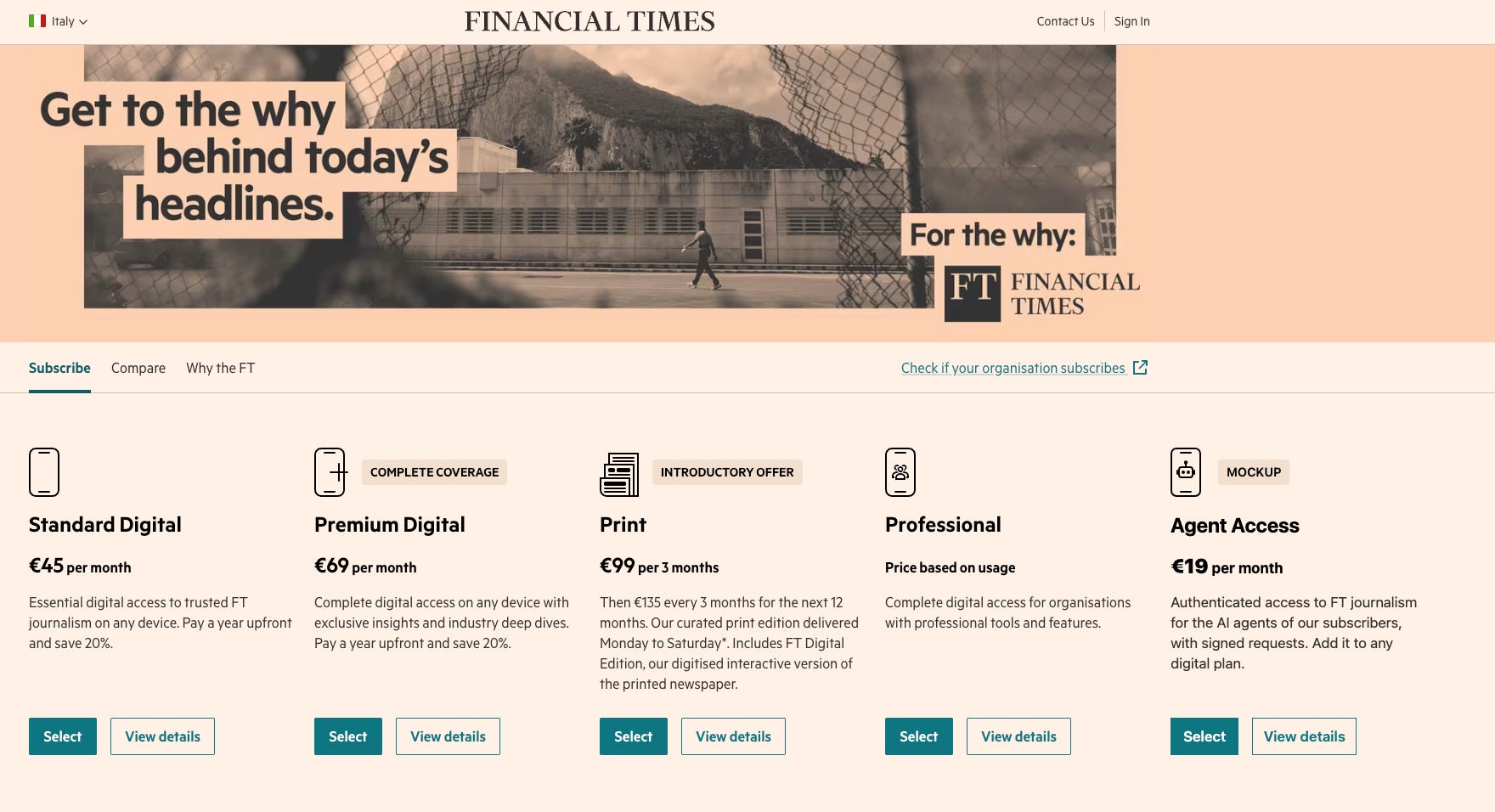
What do those who scrape the Financial Times gain from it? Today, to read those articles automatically, they have to get around a paywall. And free newspapers aren’t free ground either, because the articles are works protected by copyright. So the incentive for those who scrape is to pay a price to get out of the gray area. For the newspapers, it’s to have an economic return from an activity that today, probably, happens only in a clandestine way.
Did you like this article? Share it with someone who might find it useful and get a discount on paid plans.